
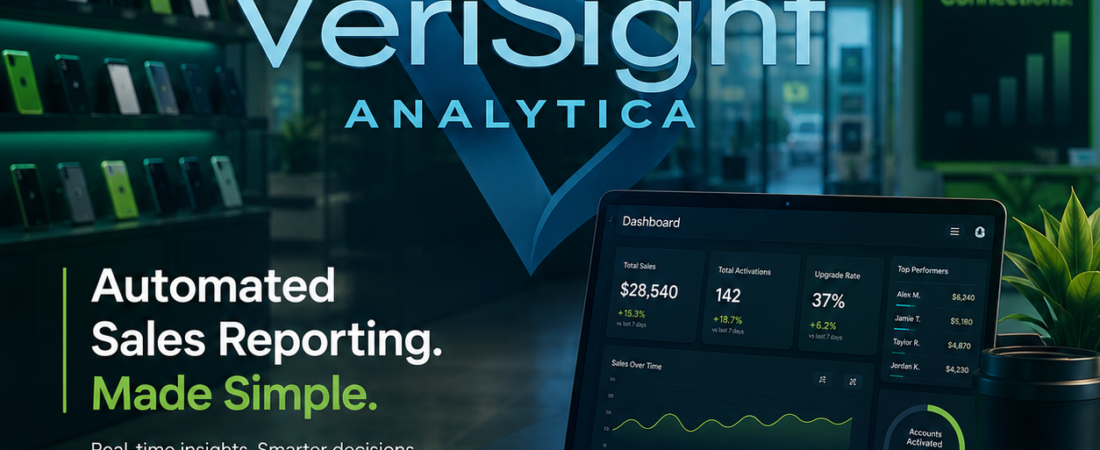
In wireless retail, performance visibility has a direct impact on team behavior.
Sales environments are naturally competitive. Reps want to know where they stand, managers need visibility into trends, and leadership depends on accurate reporting to make operational decisions.
The challenge is that many organizations still rely on fragmented or manually distributed reporting systems.
Sales numbers may live in multiple platforms. Performance updates are often delayed. Managers spend time compiling spreadsheets instead of coaching teams. In some cases, frontline employees may not see performance data until long after the selling day has ended.
Over time, this changes how teams engage with performance itself.
When visibility decreases, motivation often decreases with it.
Real-time or automated reporting systems help solve this problem by reducing the delay between performance and feedback.
Instead of waiting for manually updated reports, organizations can distribute performance data automatically through dashboards, scheduled reports, or centralized tracking systems. This creates a more transparent operating environment where managers and reps can respond to information quickly.
There are several operational advantages to this approach.
First, automated reporting improves consistency. Teams receive the same metrics in the same format on a predictable schedule, which reduces confusion and improves alignment across locations.
Second, it increases coaching opportunities. Managers who no longer spend hours assembling reports can spend more time identifying trends, recognizing strong performance, and addressing gaps in execution.
Third, it supports healthier competition.
When performance visibility is clear and timely, teams are more likely to stay engaged with goals, rankings, and KPIs. In many retail environments, motivation is reinforced when employees can consistently measure progress against peers or store benchmarks.
This becomes especially important in multi-location wireless operations where leadership may be responsible for overseeing dozens of stores simultaneously.
Without centralized reporting, operational awareness becomes difficult to maintain at scale.
Automated reporting systems help reduce that friction by creating a more reliable flow of information between frontline employees, store leadership, and upper management.
Over time, organizations often find that reporting automation is not only a data improvement initiative, but also a communication and performance management improvement initiative.
The speed and clarity of information influences how quickly teams respond, adapt, and improve. Learn more about operational reporting and visibility strategies from VeriSight Analytica.
Written by Leo Ruiz

Leo is the founder of VeriSight Analytica and writes about operational visibility, reporting systems, leadership accountability, and performance culture in wireless retail. His work focuses on how data clarity influences frontline behavior, execution, and operational consistency across multi-location retail organizations.
Learn more about operational visibility strategies from VeriSight Analytica.